
Industries
Aircraft Hangar Cleaning
Bay floors, overhead structure, shops, parts rooms, offices and crew rooms in aircraft hangars and aerospace maintenance buildings, cleaned around your aircraft moves and to your operator’s own protocol.
Hangar cleaning for the people who keep aircraft flying
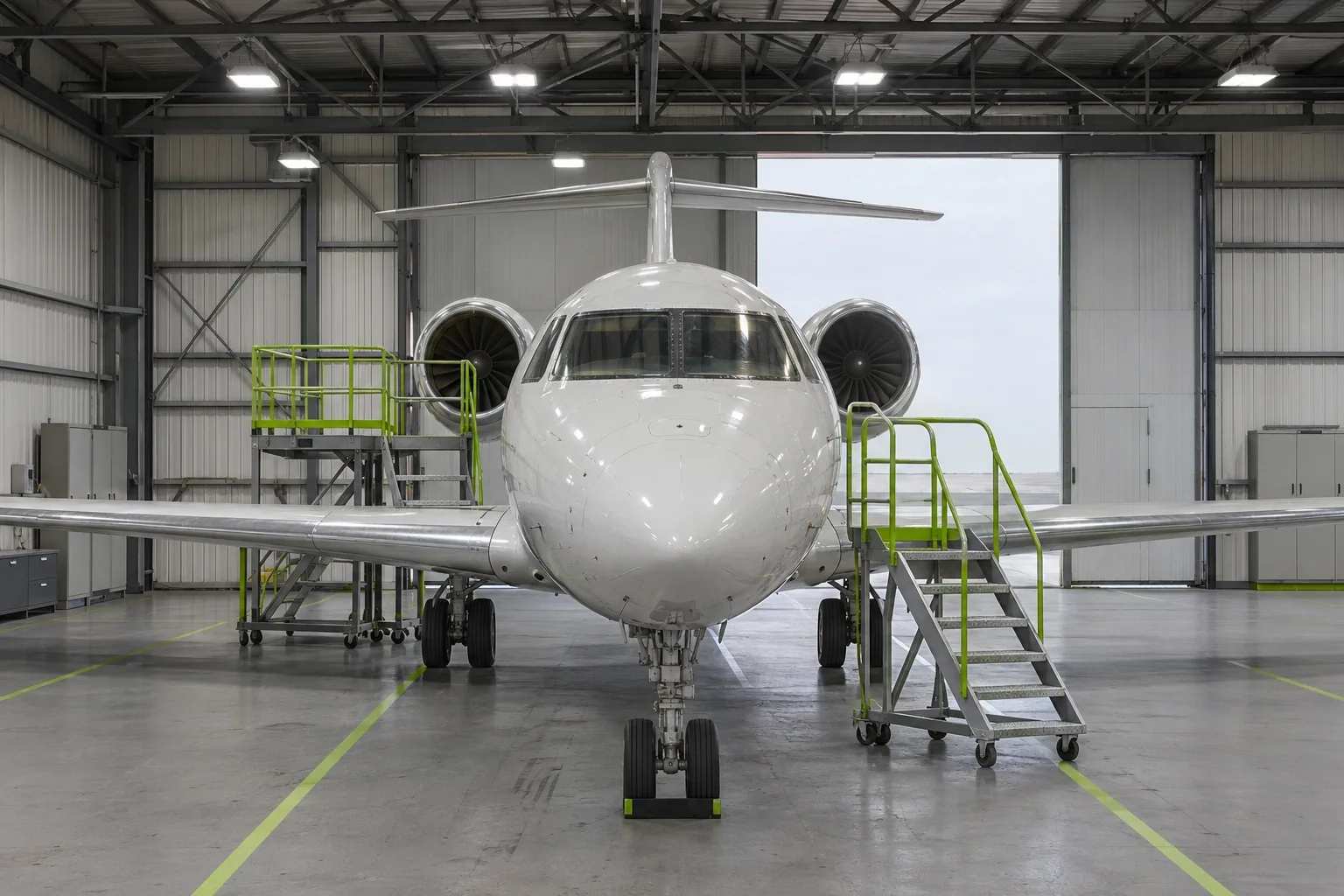
Denali cleans aircraft hangars and aerospace maintenance buildings from the bay floor to the roof trusses. The work covers storage and maintenance bays, shops and parts rooms, planning offices, crew rooms and restrooms, on a schedule built around when aircraft come in and go out.
This page is for hangar owners, maintenance managers and facility teams. Your operator’s protocol sets the rules for where crews work, when and with what water and products, and Denali builds the cleaning around it. Offices attached to the hangar can follow our industrial office cleaning, and terminals and other airport buildings are covered on our airport cleaning page.
Hangar areas and the work in each
Each area of a hangar gets its own task list, so a parts room is never cleaned like a crew lounge and the bay floor gets the attention its finish needs.
| Area | Routine visits | Periodic work |
|---|---|---|
| Maintenance and storage bay | Dust mopping and sweeping of open floor, debris pickup along safety lanes and under cleared stands | Machine scrubbing once the bay is released |
| Overhead structure | Not part of routine visits | High dusting of trusses, beams, light fixtures, unit heaters and duct exteriors from lifts |
| Shops and parts rooms | Floors swept, waste points emptied, cleared benches wiped | Concrete scrubbing in a quiet week |
| Planning offices and training rooms | Desks and touchpoints wiped, carpet vacuumed, hard floors mopped | Carpet extraction, hard floor scrub and recoat |
| Crew rooms, locker rooms and restrooms | Counters, tables and appliance fronts cleaned, restrooms disinfected and restocked | Restroom deep cleaning on a monthly or quarterly cycle |
| Entries, lobby and customer lounge | Entry glass, seating and walk-off mats kept ready for visitors | Interior and low-rise window cleaning |
Aircraft, tooling, stands and parts stay exactly where your technicians left them. Crews work in the zones your supervisor releases, and anything on a bench or a parts cart is left in place.
A light floor that shows what was dropped
The bay floor is a working surface. Military hangar design criteria (UFC 4-211-01) describe a light-gray, reflective, fuel-resistant floor that is easy to clean, so small parts and foreign objects stand out and light reaches the work under wings and fuselage. Those criteria also note that sand and dirt left on a floor act as an abrasive and dull many finishes.
The same logic holds in a civilian hangar, even though those criteria are written for military buildings. Denali works the bay dry first, then scrubs with the pads and products your operator chooses for its coating, whether that is sealed or polished concrete or a resinous system. Shop, office and break room floors are scrubbed, stripped and refinished through our industrial floor care.
Clean-as-you-go and foreign object debris
In FAA terms, foreign object debris (FOD) is anything sitting where it does not belong around an airport that could hurt someone or damage an aircraft. Its advisory circular on FOD, AC 150/5210-24A from February 2024, is guidance rather than regulation, and the airport operator applies it at its own discretion. Its habits still fit a hangar well.
The circular describes clean-as-you-go as cleaning your surroundings before, during and after a shift, and it suggests FOD containers in hangars and maintenance areas. Denali crews pick up as they work, empty the containers your team places when you ask, and hand anything that looks like hardware, such as a washer, a nut or a length of safety wire, to the supervisor on shift instead of throwing it out, because your technicians track those items.
The circular also says agreements between air carriers and their support organizations should state which party cleans which areas. Denali’s task list names every area it covers, so nobody has to guess who owns the floor under a work stand.
Foam systems, trench drains and test days
NFPA 409, the Standard on Aircraft Hangars, covers hangar construction and fire protection. Its 2026 edition was issued on November 19, 2025 and took effect on December 9, 2025, and it adds requirements for synthetic fluorine-free foam and revises the rules for low-level foam systems and drainage floor assemblies.
Accidental foam discharges are a real cost for hangar owners. In surveys from 2004 to 2021 summarized by NFPA’s Fire Protection Research Foundation, 357 of 432 hangar foam discharges were accidental. Denali crews keep clear of nozzles, detectors, monitors and manual stations, never touch, reset or block fire-protection equipment, and leave inspection and testing to the owner and its fire protection contractor.
Trench drains, floor drains and oil-water separators belong to the same group. NFPA 409 ties floor drainage to foam-protected hangars, and the owner’s team inspects and maintains it. Our crews keep debris from being swept into drains and report anything blocking a grate. Send us your system test dates: the standard’s annex says owners should notify occupants and protect or remove equipment before a test, so cleaning moves to another area that day.
Spills and rinse water
EPA lists spent washwater at air transportation facilities as a pollutant source carrying solids, metals, fuel, hydraulic fluid and oil. Its recommended practices are dry cleanup with absorbents where possible, no hosing down of areas that drain to the stormwater system, and never pouring liquid waste into floor drains, sinks or storm drains. EPA also says washwater should never go to a storm drain or surface water.
In California, the Industrial General Permit prohibits discharges other than storm water unless a permit authorizes them, and washwater is not on its list of authorized non-storm water discharges. Denali scrubs hangar floors with measured water that the machine picks back up, and the dirty water goes where your operator directs. Fuel or fluid spills are reported to your supervisor at once so your spill procedure takes over.
Lift work above the bay
Dust on trusses, light fixtures and heaters drifts down onto the floor and the aircraft parked on it. Denali does high dusting from lifts as part of our ceiling and overhead cleaning, timed for a bay that is empty or with aircraft covered or moved as your operator directs. Our guide to high dusting in plants and warehouses explains how often each overhead area needs it.
Federal OSHA rules for vehicle-mounted boom platforms (29 CFR 1910.67) require lift controls to be tested each day before use, allow only trained persons to operate the lift, and require the worker in the basket to be tied off with personal fall protection to the boom or basket, never to the building. In California, Title 8 section 3648 limits aerial devices to authorized operators. Where falling objects are possible, OSHA calls for measures such as a barricaded area kept clear of workers, so the floor under the lift is roped off while the work is overhead.
Hangars on an airfield
A hangar on an airport sits inside that airport’s security program. Under TSA rules, the program defines the air operations area (AOA) and the security identification display area (SIDA), and anyone in a SIDA displays airport-issued ID or stays under escort. The airport operator decides who gets ID and access, and Denali schedules crews to match whatever process the airport and your operator set.
Hangars on private ground or in an industrial park follow the owner’s own entry rules instead, and the work plan carries them either way.
Visits around the maintenance schedule
Offices, crew rooms and restrooms usually suit a nightly or weekday visit. The bay is cleaned when your supervisor clears it, and heavier floor and overhead work waits for the days the board shows the hangar empty. A day porter from our day and night porter services can keep restrooms and break rooms stocked through a long maintenance shift.
Denali serves hangars and aerospace buildings around Sacramento and McClellan Park, Stockton, Livermore, and Northern Nevada from Reno to Carson City. Hangar shops share a lot with production floors, so this plan can pair with our manufacturing facility cleaning.
Request a hangar cleaning quote
Tell us the bay size, the shops and offices involved, your aircraft schedule and any airfield access rules, and we will send a quote built around them. Crews are background-checked, supervisors inspect the work, and a certificate of insurance comes with every plan. Request a quote to get started.
A few useful answers
Common questions
Which parts of a hangar does Denali clean?
Bay floors, overhead structure from lifts, shops, parts rooms, offices, crew rooms, locker rooms and restrooms, each on its own task list and frequency.
How are bolts, washers or safety wire found on the floor handled?
Crews set them aside and hand them to your supervisor on shift, so your technicians can account for every piece of hardware.
Can the trusses, lights and heaters above the bay be dusted?
Yes. Denali does high dusting from lifts, with the floor below roped off and aircraft moved or covered as your operator directs.
Who decides when crews work on the hangar floor?
Your maintenance supervisor. Crews clean the zones released for that visit and move heavier floor work to days the bay is empty.
Can the hangar offices and crew rooms be cleaned nightly while the bay runs on its own cycle?
Yes. Offices and crew rooms follow a nightly or weekday schedule, and the bay floor and overhead work run on separate cycles.